Moving from reflection to intentional action when life is still unfolding.
Part 3 of the series: Moving Forward When Life Has Changed
There comes a point in many life transitions when we begin asking a different kind of question.
We've spent time coming to terms with what's changed. We've wrestled with uncertainty, acknowledged what we've lost, and perhaps begun discovering things about ourselves that we hadn't noticed before. But eventually, another question begins to surface:
What do I do with what I'm learning?
It's one thing to recognize that life has changed. It's another to begin imagining how we want to live in light of those changes. And that can feel both exciting and intimidating.
For some, the possibilities seem endless. For others, the options feel painfully limited. We may have a growing sense of what matters but little clarity about how to translate those discoveries into everyday decisions.
This is where I believe an important shift can happen in the transition journey. We begin moving from simply responding to what's changed toward intentionally participating in what comes next. I call this movement Design.
From Understanding Change to Shaping What Comes Next
In my work as a transitions coach, I've developed an approach called the Navigate Change Framework™, built around three interconnected movements: Discern, Discover, and Design.
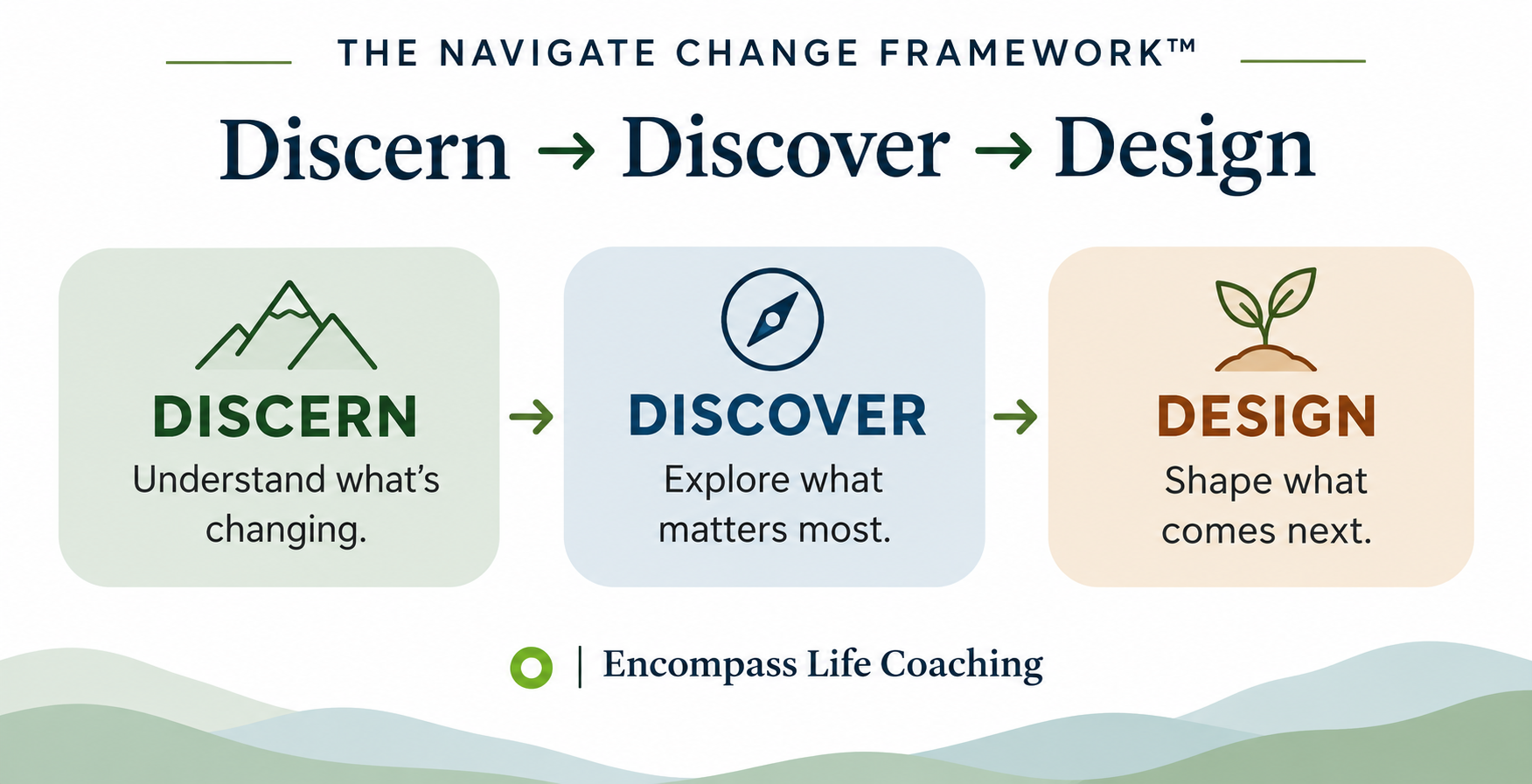
Each movement invites us to engage with transition in a different way.
Discern begins with paying attention to what's changing and how those changes are affecting us. It helps us recognize the losses, uncertainties, tensions, and opportunities that often accompany significant life transitions.
Discover invites us to explore what we're learning about ourselves along the way. What matters most now? What needs, values, strengths, and priorities deserve greater attention? What might be emerging as our understanding of ourselves and our circumstances evolves?
And then there's Design.
Design is about taking what we've discerned and discovered and beginning to translate those insights into intentional choices, meaningful experiments, and practical steps forward. It's the movement from awareness toward action.
But there's something important to understand about Design: We're not trying to create a perfect plan for the future. We're learning to shape our next season in ways that reflect what matters most. That distinction makes all the difference.
Design Isn't About Controlling the Future
In the previous article, Grounded in the Unfinished, we explored the tension between our desire for certainty and the invitation to remain grounded while life is still unfolding.
We considered how faith, values, and trust can anchor us even when we don't know exactly what's next. Design builds on that foundation.
At first, the idea of designing our future might sound like another attempt to take control. After all, we often associate design with blueprints, detailed plans, and predetermined outcomes. But healthy design during transition looks quite different.
It begins with acknowledging that we don't control every circumstance, opportunity, or outcome. We can't guarantee how things will unfold, and we may need to revise our expectations along the way.
What we can do is become more intentional about the choices available to us. We can identify priorities, explore possibilities, create healthier rhythms, and take steps that align with our values and commitments. We can also give ourselves permission to learn and adjust as we go.
For people of faith, I believe this is an important expression of stewardship. We can trust God with what we cannot control while taking responsibility for the opportunities, relationships, and decisions entrusted to us.
Design isn't about forcing the future into the shape we want. It's about faithfully and intentionally engaging with the life that's unfolding before us.
Begin with What Matters Most
One of the most common challenges I see in transition is the temptation to build our next chapter around what seems immediately available or expected.
A new job opportunity appears, so we pursue it. Someone suggests a direction, and we feel pressure to consider it. We look at what others are doing and wonder whether we should be doing something similar.
None of these responses is necessarily wrong. But they can lead us into decisions before we've considered whether those choices reflect what matters most to us.
This is why the Discover movement is so important. Before we begin designing what's next, we need to pay attention to what we've learned about our values, needs, priorities, and sense of purpose- and God's invitation in all of that.
Imagine someone who has spent years in a demanding leadership role. The work has been meaningful, but the pace has taken a toll on their relationships, health, and personal well-being.
As they navigate a transition out of that role, they may discover that they still value meaningful work and opportunities to lead. But they may also recognize a growing need for margin, deeper relationships, and a more sustainable rhythm of life.
Without that awareness, they might simply pursue another position that looks much like the one they've left. But with greater clarity about what matters most, they can begin asking different questions.
What kind of work would allow me to contribute meaningfully without sacrificing the relationships I value? What boundaries or rhythms would support a healthier way of living? What might I need to do differently rather than simply finding a different place to do the same things?
These questions don't necessarily produce immediate answers. But they begin shaping the criteria for what comes next. And that's an important part of Design.
Think in Possibilities, Not Just Decisions
Another way we can become stuck during transition is by treating every choice as though it must be permanent. We feel pressure to identify the right career, the right ministry role, the right place to live, or the right next step.
The stakes feel high, and the fear of making a mistake can leave us hesitant to act. But what if we approached our next season with more curiosity and less pressure?
Rather than asking, "What's the one right decision I need to make?" we might ask, "What possibilities are worth exploring?" That shift opens the door to experimentation.
Someone considering a career change might begin with conversations, informational interviews, or a short-term project rather than immediately committing to a new direction.
A person navigating retirement might explore volunteer opportunities, new interests, or different rhythms of service before deciding how they want to structure their days.
Someone emerging from a difficult season of loss might begin by rebuilding meaningful connections or rediscovering activities that bring a sense of life and purpose.
These aren't necessarily final decisions. They're opportunities to learn.
In coaching, I often encourage people to think about small, intentional experiments—steps that allow them to test possibilities, gain insight, and make adjustments before committing to something larger.
This approach helps us move beyond all-or-nothing thinking. We don't have to choose between remaining stuck and making a life-altering decision. There's often a great deal of meaningful movement available in between.
Designing a Life, Not Just a Next Step
When we think about transition, it's easy to focus on the most visible decision in front of us.
What job should I pursue? Where should we live? What role should I take on? What opportunity should I accept? But Design invites us to consider something broader.
We're not simply choosing our next activity or position. We're considering how we want to live. That includes our relationships, daily rhythms, spiritual life, personal well-being, sense of contribution, and the commitments that shape our time and energy.
Sometimes the most important design decisions aren't dramatic at all. They might involve protecting time for family, creating space for rest and reflection, establishing healthier boundaries, reconnecting with community, or choosing to invest more intentionally in something we've neglected.
These decisions may not look impressive from the outside, but they can profoundly influence the quality and direction of our lives.
I think this is particularly important for people navigating transitions after years of responsibility, leadership, or service. It's possible to move into a new role without changing the patterns that contributed to exhaustion or dissatisfaction in the previous one.
Design gives us an opportunity to ask not only what we want to do next, but what kind of life we want our choices to support.
Four Questions to Help You Begin Designing What's Next
If you're navigating a season of transition, here are four questions that may help you begin moving from reflection toward intentional action.
1. What have I discovered about what matters most to me?
Think about the values, relationships, needs, and priorities that have become clearer through your transition. Which of these deserve greater attention as you consider your next season?
2. What possibilities am I curious about?
Set aside, for a moment, the pressure to make a final decision. What opportunities, interests, or directions would you like to explore? What might you learn by giving yourself permission to be curious?
3. What would I like to do differently moving forward?
Consider the patterns, expectations, and rhythms of your previous season. What would you like to carry forward? What might need to change? What do you want to leave behind?
4. What's one small experiment I could try?
Identify a practical step that would allow you to explore a possibility or begin aligning your life more closely with what matters most. Keep it small enough that you can learn from the experience without feeling locked into a permanent decision.
You don't need to answer every question immediately. Even choosing one to reflect on can help you begin seeing possibilities that weren't obvious before.
You Can Begin Before the Picture Is Complete
One of the things I've come to appreciate about transition is that clarity and action often develop together. We may wish we could understand everything before taking a step, but sometimes it's through taking a step that we discover something important.
A conversation opens a new possibility. An experiment reveals an unexpected interest. A small change in our daily rhythms helps us recognize what we've been missing. And occasionally, we discover that something we thought we wanted isn't actually the right fit. That's not necessarily failure. It's learning.
The movements of Discern, Discover, and Design aren't rigid stages we complete once and leave behind. They're interconnected practices we return to as our circumstances and understanding evolve. We discern what's happening. We discover what matters. We design intentional responses. And as we learn, we continue discerning, discovering, and adjusting.
For those of us who approach life through faith, this can also become a practice of ongoing trust—participating actively in the choices before us while remaining open to God's guidance and the possibilities we cannot yet see.
We don't have to wait until the future is certain to begin shaping it with intention.
Sometimes the next chapter begins not with a grand decision, but with a small, thoughtful step that reflects who we are, what we value, and who we're becoming.
And that is where Design begins.
Next in the series: Small Steps Toward a New Beginning — How meaningful action, experimentation, and reflection help us move forward with greater clarity and confidence.
-Tim
P.S. Are you navigating a significant life, career, ministry, or leadership transition? I'd love to invite you to my final Navigating Transition Live Workshop of 2026 on Tuesday, December 8.
This interactive online workshop offers a supportive space to better understand the changes you're experiencing, explore what matters most, and identify practical ways to move forward with greater clarity and confidence.
Whether you're feeling stuck, living in the uncertainty of the in-between, or beginning to consider what's next, this workshop is designed to help you navigate your transition more intentionally.
Learn more and register for the December 8 Navigating Transition Workshop
Join us if you can.