

You Don't Have to Process Transition Alone
Transition can feel uniquely isolating — even for capable leaders. While frameworks and clarity matter, discernment deepens in conversation. This final reflection explores why you don’t have to navigate change alone.
There is something uniquely isolating about transition.
Even capable, well-supported leaders often find themselves quietly carrying questions they don’t voice out loud:
Am I reading this season correctly?
What if I disappoint someone?
What if I get this wrong?
Transition stretches identity, responsibility, and belonging. It asks us to hold tension without rushing resolution. And even when we understand the frameworks — the curve, the impact, the tensions — there is still the lived experience of walking it out.
That’s where many people grow tired. Not because they lack wisdom. But because they are trying to process and arrive at clarity alone.
Discernment is not meant to be a solo activity.
It deepens in conversation.
It steadies in reflection with another.
It clarifies when someone asks a wise question at the right time.
Over the past few weeks in this series, we’ve explored:
How to recognize a true season of transition
How change impacts multiple areas of life
Why good decisions still feel hard
Why clarity often follows movement
All of those tools matter. But they are most powerful when held in shared space.
If you regularly walk alongside others in transition — as a coach, pastor, leader, or friend — I’m hosting a 90-minute live webinar on May 19th designed to equip you with practical frameworks and deeper understanding for these seasons.
And if you yourself are navigating change, sometimes the next intentional step isn’t a new strategy — it’s an honest conversation.
You don’t have to process this season alone.
—Tim
P.S. If the May 19th Walking with People in Transition webinar would serve you or someone you support, you can learn more and register here.
And if you’re sensing that this season deserves more focused attention, I’m always open to a conversation about 1:1 coaching.

Why Clarity Doesn't Come First
We often assume clarity must come before movement. But in seasons of transition, clarity is usually discovered along the way. This reflection explores why waiting for certainty can keep us stuck—and how discernment grows as we take thoughtful steps forward.
One of the most common expectations I hear in transition is this:
“I just need clarity.”
It sounds reasonable. Responsible, even. After all, clarity feels like the prerequisite to wise decision-making. If we could just see the full picture, then we would move forward confidently.
But in most transitions, clarity does not come first. Movement does. And that can feel deeply unsettling.
The Myth of Preloaded Clarity
Many capable leaders assume clarity should arrive fully formed — downloaded through prayer, reflection, or extended thinking. When it doesn’t, they often conclude something must be wrong:
Maybe I’m not listening well enough.
Maybe I’m not praying enough.
Maybe I’m missing something obvious.
But transition rarely works that way. Clarity is often the result of movement, not the requirement for it. It emerges gradually as we take thoughtful steps, test assumptions, ask better questions, and pay attention to what surfaces along the way.
Why We Resist Moving Without Certainty
There’s a reason we wait. When identity, responsibility, and belonging feel at stake, moving without certainty feels risky. We want reassurance before we act. We want a map before we take a step. Yet most meaningful transitions involve some degree of ambiguity. We are asked to walk forward without full visibility. Consider God’s instructions to Abram in the Bible:
The Lord had said to Abram, “Go from your country, your people and your father’s household to the land I will show you. - Genesis 12:1
Sometimes we find direction within the movement rather than outside of it. This is not recklessness. It is discernment in motion.
Discernment Is Different Than Certainty
Certainty seeks guarantees. Discernment seeks alignment.
Certainty asks, “How can I be sure this will work?” Discernment asks, “What feels most aligned with my values, calling, and season right now?”
The first question often leads to paralysis. The second creates room for movement.
In my work with leaders navigating change, I’ve seen that clarity tends to grow as people begin to engage the process — naming what’s shifting, acknowledging tension, and identifying what matters most. Clarity is rarely found at the beginning of transition. It is discovered along the way.
For Those Who Walk with Others
If you regularly accompany others through seasons of change, this distinction matters. Many people you guide will believe they need more clarity before they can act. What they may need instead is permission to move thoughtfully without having every answer. Helping someone discern is not about providing certainty. It is about creating space for wise movement.
That’s part of what we’ll explore more deeply in the upcoming Walking with People in Transition webinar on May 19th. We’ll look at how to recognize when someone is waiting for certainty — and how to guide them toward discernment instead.
But whether you join us or not, remember this: You do not need full clarity to take your next faithful step. Often, the next step is what brings clarity into view.
-Tim
P.S. If you’re in a season where you’ve been waiting for certainty before moving forward, consider this question: What small, values-aligned step could I take — not because I’m certain, but because it’s faithful to what I know right now?

Why Good Decisions Still Feel So Hard
Even when a decision makes sense, something inside can still feel unsettled. This reflection explores the hidden tensions that surface during transition—and why naming fear often leads to deeper clarity.
In the first two reflections, we’ve named something many leaders quietly experience in seasons of change.
First, the recognition: you’re not stuck — you’re in transition.
Then, the impact: transition rarely touches just one part of life.
But there’s another layer beneath both of those.
Even when a path forward seems wise, something inside can still feel unsettled. Even when a decision aligns on paper, tension lingers.
Why? Because transition doesn’t just disrupt circumstances. It surfaces fear.
The Tensions Beneath the Surface
One of the frameworks I use when walking with leaders through change is what I call the Core Tensions Framework. It highlights three areas where fear commonly rises during transition: identity and calling, family and relationships, and community and belonging.
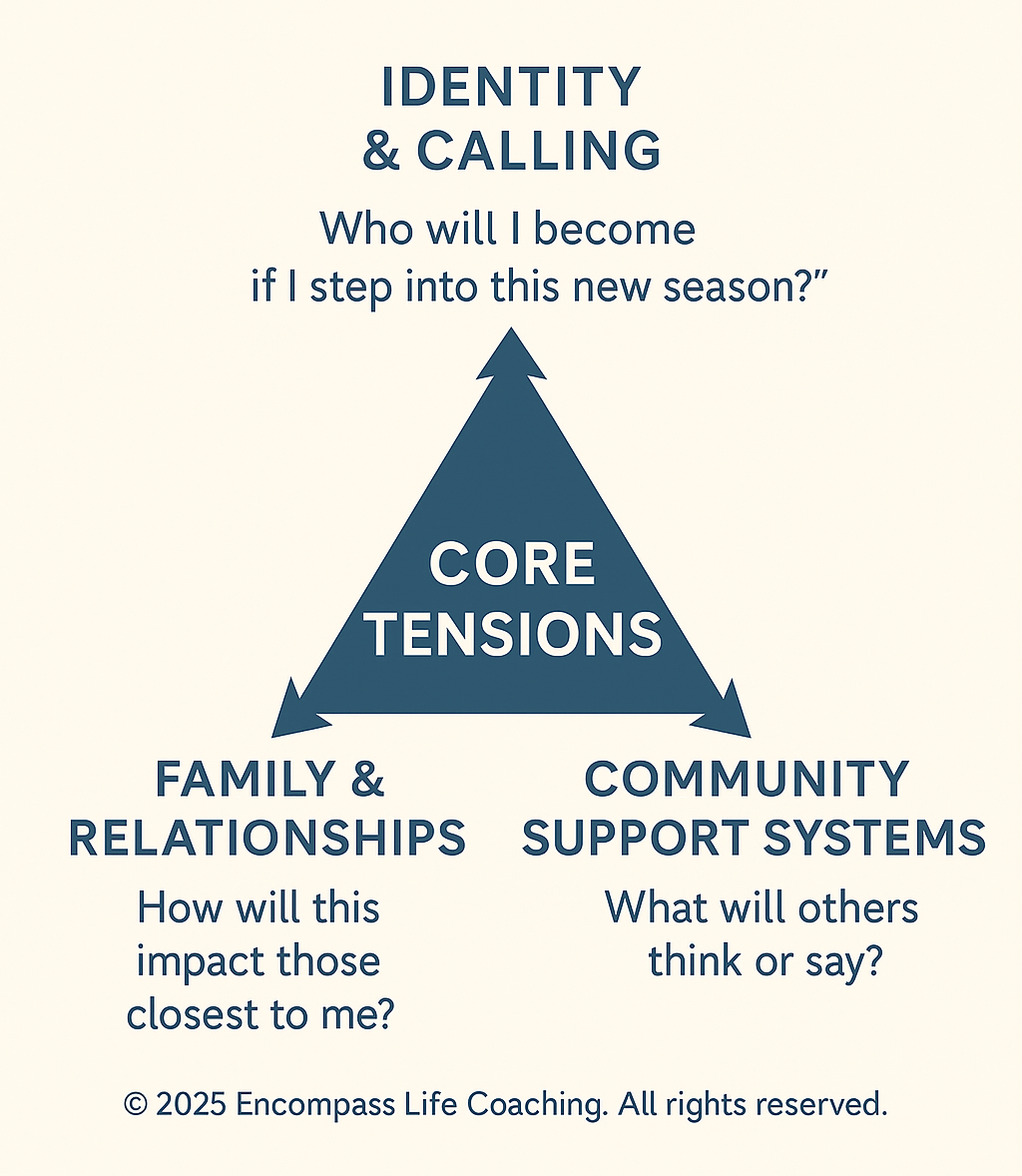
These are not problems to eliminate. They are tensions to manage, to steward.
When transition touches identity, the questions often become deeply personal: Who am I if this role shifts? What does faithfulness look like in this new season? Am I stepping toward or away from my calling?
Family and relationships introduce another layer. No decision is made in isolation. We often carry not only our own uncertainty but the weight of how change will affect those closest to us. Even a wise move can feel costly when others are involved.
And then there is belonging. Transition frequently disrupts community expectations. Where will I fit now? What assumptions will others make? Am I stepping outside the story people thought I was living?
These tensions do not necessarily signal that something is wrong. They often reveal what we most want to value and embrace.
Tension Is Not the Enemy
When someone in transition says, “I feel torn,” our instinct — especially if we care about them — is to help resolve that tension quickly. But discernment is not the elimination of fear. It is the patient naming of it.
Often the more helpful question is not, “What should you do?” but, “What feels most at risk here?”
When fear is named honestly — identity, responsibility, belonging — clarity begins to deepen. Not because the tension disappears, but because it is no longer hidden.
A Reflection for You
If you are personally navigating change, which of these tensions feels most alive right now? And if you regularly walk alongside others in transition, where do you most often see the struggle emerge — identity, relationships, or belonging?
Naming tension does not rush resolution. It creates space for wisdom.
Walking With Others Through the Tension
On May 19th at 12 PM MST, I’ll be hosting the next Walking with People in Transition webinar.
This session is designed primarily for those who accompany others through seasons of change — coaches, pastors, leaders, and mentors. We’ll explore frameworks like the Transition Curve, the Impact Assessment, and the Core Tensions Framework — not as scripts to follow, but as lenses that help you listen more deeply and ask wiser questions.
If you regularly sit with people who feel torn between identity, responsibility, and belonging, this space may give structure and language to what you’re already sensing. And if you find yourself in transition personally, you’re welcome as well. Details are available on the site, and I’ll share more as we get closer.
Transitions stretch us not because we are weak, but because they touch the deepest parts of who we are. Identity. Relationship. Belonging.
Those are worth tending carefully.
— Tim
P.S.
If you feel the urge to relieve someone’s tension quickly this week — or your own — consider slowing down instead. Could it be that wisdom wants to grow in the space between fear and decision?