

There’s a moment many leaders reach when effort stops producing clarity.
You’re still faithful.
Still responsible.
Still showing up.
But something feels off.
Energy is lower than it used to be. Motivation comes and goes. The strategies that once worked don’t seem to land the same way anymore. You might even find yourself wondering, “Is something wrong with me?”
Often, nothing is wrong at all.
You may not be failing.
You may not be burned out.
You may be in transition.
Why Transitions Are So Hard to Recognize
Transitions rarely announce themselves clearly. They don’t arrive with a formal invitation or a checklist of next steps. Instead, they show up quietly—through loss, restlessness, disorientation, or a growing sense that a chapter is closing even if the next one hasn’t begun.
Most of us were taught to interpret these feelings as problems to solve or obstacles to push through. But transitions don’t respond well to pressure. In fact, pushing harder often makes the fog thicker.
That’s because transitions aren’t just about change. They’re about letting go, waiting, and eventually becoming.
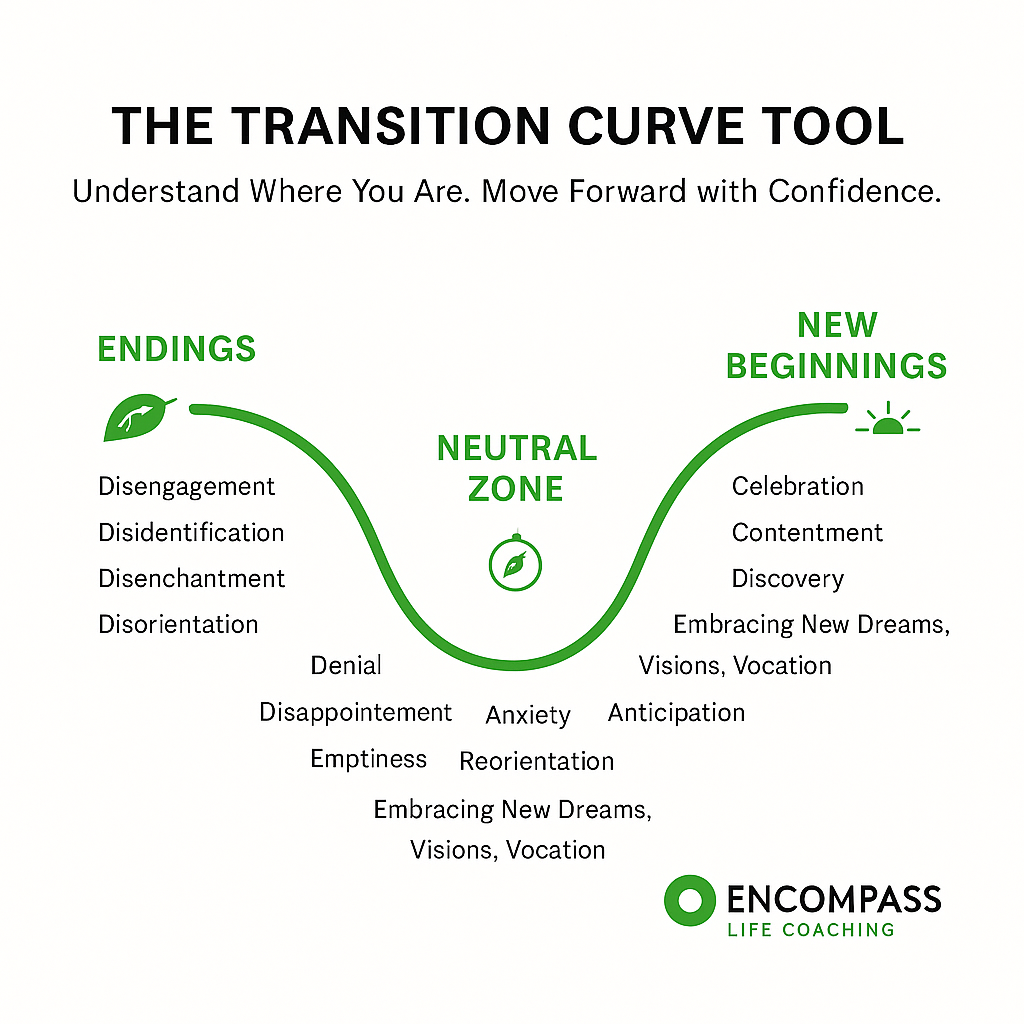
One of the most helpful tools I use in transition work is something called the Transition Curve. It names three common phases people move through during significant life transitions. You don’t need to identify with everything here—often one or two words are enough to recognize where you are.
Many people are surprised by how much relief comes from simply seeing their experience reflected here.
1. Endings
This is where something familiar is coming to a close—sometimes by choice, sometimes not. Endings often carry a mix of emotions: grief, relief, disappointment, confusion, even celebration. What’s ending might be a role, a season of ministry, a sense of identity, or a long-held expectation.
And here’s something to remember: Even good endings involve loss.
2. The Neutral Zone
This is the space most people dislike the most—and try to escape the fastest. The Neutral Zone is marked by uncertainty, lower energy, disorientation, and often reduced productivity. The old way no longer fits, but the new way hasn’t taken shape yet.
Here’s the important part: The Neutral Zone is not a mistake.
It’s a necessary space where real discernment happens. Creativity, clarity, and new direction are often formed here—but slowly.
3. New Beginnings
Eventually, something new starts to emerge. There’s tentative hope, curiosity, and a growing sense of alignment. New language forms. New commitments take shape. But this phase can’t be rushed. It only comes after Endings are honored and the Neutral Zone is lived through.
Why “Waiting It Out” Rarely Works
Many leaders try to survive transition by telling themselves, “I just need to get through this.” But transitions aren’t something you get through—they’re something you move with.
When you treat a transition like a delay or disruption instead of a process, you may:
Rush decisions to relieve discomfort
Over-spiritualize uncertainty instead of discerning it
Assume low energy means you’re doing something wrong
In reality, transitions often ask for a different posture—not more effort, but more attentiveness.
A Gentle Invitation
If any of this resonates, here’s a simple place to start—not to fix anything, just to notice:
What feels like it’s ending in my life or leadership right now?
What feels unclear, unfinished, or “in between”?
Where might I be expecting clarity too early?
You don’t need answers yet.
You don’t need a five-year plan.
You may simply need permission to name where you are.
While transitions often feel like disruptions, they are often fertile ground for clarity, renewed purpose and growth.
—Tim
P.S.
If you’ve been feeling stuck, weary, or quietly unsettled, you don’t have to navigate that alone. Much of my work is simply creating space for leaders to locate themselves honestly, name what’s shifting, and discern next steps without rushing. If that kind of space would be helpful, I’d be glad to walk with you.