
Anchor Points
Transitions bring disruption and upheaval. In transition seasons we may come to a point where we no longer recognize our lives. But what if we could build some intentionality into the process of change? How could it help us stay more grounded, hopeful, and purposeful through the uncertainty of it all?
Transitions bring disruption and upheaval. In transition seasons we may come to a point where we no longer recognize our lives. The steadiness and stability we once knew seems distant and out of reach. We want to hold on through the winds and waves of change, but to what? What is there to cling to?
It’s easy to give up on the idea of maintaining structure and routine through transition seasons. What’s the use anyway? Constant change will just sabotage my efforts. And so, we let the current of transition take us where it will, with the hope that we won’t drift too far or, worse yet, drown in the process.
What if we could build some intentionality into the process of change? How could it help us stay more grounded, hopeful, and purposeful through the uncertainty of it all?
I’d like to share some insights I’ve gathered along the way, particularly as it relates to building structure and routine into these times of uncertainty. I’ll be referring to them as anchor points, but other useful language could be holds or non-negotiables.
WHAT ARE YOUR ANCHOR POINTS?
Anchor points can be anything we do to create a sense of stability in the messiness and uncertainty of change. They mostly center around rhythms of rest, routines and relationships. They are intentional ways we want to steward time and leverage opportunities for overall health and growth.
I see anchor points as non-negotiables, with the expectation that flexibility will be necessary while navigating transition. Imagine pulling up the anchor, rowing to another spot, then anchoring down once again. Our weekly date night gets disrupted. What other options do we have for quality time together? My morning quiet time needs to shift. No worries. Tomorrow is a new day. Actually, I have a one-hour window this evening. Win!
It’s usually better to tweak a non-negotiable than to give up on it altogether. Yes, God gives us do-overs, restarts and second chances. Do you see a grace principle at work here?
Having anchor points reminds us that we are not defined merely by the changes taking place. We are more than that. Even though transition can challenge one’s sense of identity and purpose, God can also use it to remind us of who we are in Him. That’s such a stabilizing force!
Anchor points play a critical role in building the muscle of resilience. It’s a balancing act for sure. We adapt and flex with the changes around us, even while staying committed to rhythms and routines which ground us. In this way, transition can take on its own unique cadence designed by God uniquely for us, for a season.
Here’s a few ways to establish anchor points in transition seasons…
• Focus on what you CAN do instead of what you can’t. Limitations are real in transition. Capacity can be lower, options more limited. But at the same time, it can be a very creative season, allowing us to explore and experiment with out-of-the-box ideas and practices, which in turn can become new anchor points, at least for a season.
• Reflect and re-anchor weekly, if not daily. Priorities tend to change more frequently in transition. Decision fatigue can set in. To remain grounded and focused on what matters most, it’s important to pause and re-order priorities prayerfully and regularly. I like to sit down weekly and ask myself a series of questions, something I call Reflection Point. Feel free to download these questions HERE and use them or some variation of them if you find it helpful.
• Focus on being, not just doing. This can be especially helpful when we find ourselves in prolonged holding patterns, with not a whole lot to do. Following 20 years of life overseas and facing a big transition, I faced an identity struggle. Who was I apart from the roles and titles that defined me all those years? By focusing on God’s invitation to be with him and to define myself in new ways based on my relationship to Him, I was able to let go of a false sense of identity and become more anchored in what really matters.
Do you have anchor points that have helped you navigate transition? I’d love to hear from you.
As you reflect on this post, what comes to mind? What are some ways you tend to drift in transition? What are some routines and rhythms that could help you stay anchored?

Looking for a transitions coach with a proven track record of helping his clients successfully navigate change? Schedule your discovery call HERE.
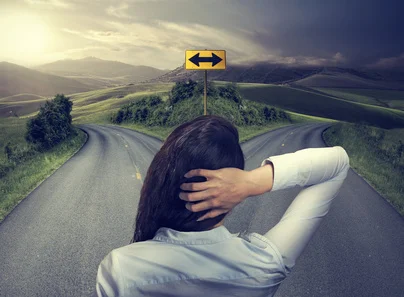
Crossroads and the Big Decisions
God’s way, I've come to realize, is transition. And it works its wonders differently each time. One thing is certain: transition leads us to the crossroads of decision. Here are some important steps to take when navigating your transition crossroads...
God’s way, I've come to realize, is transition.
Oh, it feels different each time. Sometimes change hits us abruptly, with no warning whatsoever. Or it can be subtle, like the first signs of fall after a long summer. Transition can serve as a boot camp of sorts, preparing us for some bold new adventure. Sometimes mostly outward circumstances change. Other times big internal shifts take place, impacting core values, identity and purpose.
One thing is certain: transitions lead us to the crossroads of decision.
Recently, on the heels of a major transition, I came across this invitation from scripture:
“Stand at the crossroads and look; ask for the ancient paths, ask where the good way is, and walk in it, and you will find rest for your souls. But you said, ‘We will not walk in it.’”
Take Time to Stand…
Transitions are opportunities to stand between the juncture of two or more paths and consider the options. A posture of stillness prepares us to see what we may otherwise not see and to make navigational adjustments while it’s not too late. Fools rush in, so the saying goes. Nonetheless one part of me wants to heed the world’s urgent call to action, “Don't just stand there, do something!”
Standing, in one sense, is stopping long enough to make sense of it all.
Our fast-paced culture tends to downplay the need for disciplines like stillness and solitude. But what if there is more heroism in the act of standing than we would dare to think? When we take time to put on the brakes and to stand at a crossroads we are more likely to end up in a good place when it’s all said and done...
“Be prepared. You’re up against far more than you can handle on your own. Take all the help you can get, every weapon God has issued, so that when it’s all over but the shouting you’ll still be on your feet.”
Look Again. What do you See?
There is more to the process than simply stopping. It's possible to stop and stand at a crossroads yet miss the message. So, what can we do?
During a recent transition, being presented with another big decision made me want to crawl into a hole. The wisest counsel I received was to pause, to give myself time and space to breathe. Difficult transitions can be complicated by decision fatigue, “the deteriorating quality of decisions made by an individual after a long session (or in my case season) of decision making.” (Wikipedia). During these times why not linger a bit at the crossroads, allowing God’s unhurried wisdom and counsel to take over?
When we pause long enough and observe closely, we may find ourselves moving beyond merely looking at the fog and thus raising the stress level; we actually may begin seeing options and opportunities through the fog!
When it’s time to ask…
At some stage of transition we need to inquire. We need to ask for clarity, for direction.
Asking well requires the art of a waiting with a listening ear. Do you ever get annoyed when someone asks you a question but doesn't wait for the answer? My wife can tell you that I have a tendency of not stopping long enough to hear the answer to the question I'm asking, especially in decision fatigue moments. Thankfully she gives me more patience and grace than I deserve.
Ancient paths are the good ways. They are proven and trustworthy. but they are not necessarily the most well-worn. It takes courage, discipline and a sense of adventure in order to trod these paths (for more read Hebrews 11 in the Bible). Are we stopping long enough and with intentionality to see the best options, the God-honoring ones?
Walk in it…
Take it…the road that is. At some critical juncture we must heed the call to action. What will it take to walk in the path you are now destined for? Through the process of standing, observing and asking, you can reach the clarity and confidence to pursue new, unfamiliar paths. A personal guide awaits us,
“But I’ll take the hand of those who don’t know the way, who can’t see where they’re going. I’ll be a personal guide to them, directing them through unknown country. I’ll be right there to show them what roads to take, make sure they don’t fall into the ditch. These are the things I’ll be doing for them—sticking with them, not leaving them for a minute.”
What do you need to move forward? Courage? Accountability? Rest?
Rest…
Believe it or not, this is really the goal of the whole process…to enter into rest, a quiet, unhurried confidence which has learned the secret of walking with the Creator through times of transition.
Moving forward at a crossroads is something that can be greatly enhanced by working with a life coach specializing in transitions. Need a supportive partner to journey with you in transition or know someone who does? Contact us HERE.